Insurance is the only product in modern history that we buy with real, hard-earned money while silently praying to never, ever use it. It sits quietly on autopay alongside gym memberships we forget to cancel and video streaming services we barely watch. Yet, ignoring it until an actual emergency hits is like finding out your parachute is really just an oversized floral napkin on your way out of the plane.
Heading into 2027, the economic landscape feels weirdly different. Rebuilding costs for homes have climbed, hospital bills look like international phone numbers, and replacing a busted bumper on a modern car requires a team of software engineers and a bank loan. Figuring out whether you have enough coverage doesn’t require a finance degree, but it does require 15 minutes of honest reckoning with reality.
The Goldilocks Dilemma: Over-Insured vs. Under-Insured
Finding the right coverage is basically the story of Goldilocks, except instead of porridge, you are balancing premiums against complete financial ruin.
If you are under-insured, one rogue hailstorm or minor fender bender with an electric luxury SUV can wipe out your emergency fund in three business days. If you are over-insured, you are basically donating money every month to a corporate giant that uses your premiums to pay a retired athlete to act in funny commercials.
The sweet spot is covering the disasters you genuinely cannot survive out of pocket, while skipping the frivolous add-ons that exist solely to pad an agent’s monthly commission.
Life Insurance: Calculating Your Family’s Safety Net
Life insurance feels awkward to think about because it requires planning for a world where you aren’t around to enjoy the Netflix queue. But if anyone relies on your paycheck to eat, sleep under a roof, or go to school, having coverage is non-negotiable.
The Modern Rules of Thumb
The old-school advice was simply “buy ten times your salary.” That is a fine starting point if your life fits into a neat 1990s sitcom template, but 2027 expenses hit differently. A far more realistic approach uses the DIME formula:
-
Debt: Tally up every personal loan, credit card balance, and student loan you don’t want your co-signers inheriting.
-
Income: Multiply your current take-home pay by the number of years your family needs support (usually 8 to 12 years).
-
Mortgage: Add the full payoff balance of your home loan so your family keeps the roof over their heads.
-
Education: Estimate tuition and living costs for each child you plan to launch into adulthood.
Coverage Needs by Life Stage
| Life Stage | Primary Objective | Typical Target Coverage |
| Single, No Dependents | Cover final expenses and private student debt | $25,000 – $50,000 |
| Married, No Kids | Cover shared mortgage, debts, and income buffer | 5x – 7x Combined Annual Income |
| Parents with Young Kids | Full income replacement, mortgage payoff, college funds | 10x – 15x Annual Income |
| Empty Nesters / Near Retirement | Estate settlement and surviving spouse income | 2x – 5x Annual Income (or self-insured) |
If you are shopping, stick to term life insurance. Whole life insurance sounds tempting with its “cash value” promises, but it is notorious for high administrative fees and underwhelming returns. Buy cheap term coverage for the 20 or 30 years you need it, and invest the rest of your cash somewhere sensible.
Health and Disability: Protecting the Paycheck Machine
Most people obsess over protecting their car or their house, completely forgetting that the machine funding the entire show is their own body. If your body stops working on Monday morning, every other bill keeps showing up right on schedule.
Health Insurance: Stop Looking Just at the Monthly Premium
Picking a health plan based only on the lowest monthly premium is a rookie mistake. A dirt-cheap plan with an $8,500 deductible means you are basically paying for catastrophic protection, and you will pay full price out-of-pocket for every doctor visit and prescription until you break a major bone.
-
High-Deductible Health Plans (HDHP): Great if you are healthy, rarely visit the doctor, and aggressively fund a Health Savings Account (HSA).
-
PPO or Low-Deductible Plans: Ideal if you take maintenance medications, manage chronic conditions, or have toddlers who treat living room furniture like an obstacle course.
Disability Insurance: The Forgotten Essential
You are far more likely to become temporarily or permanently disabled during your working career than to pass away prematurely. Short-term disability handles a few weeks or months, but long-term disability is the heavy lifter.
Look for a policy that replaces 60% to 70% of your gross income, with a 90-day waiting period. Make sure it specifies “own-occupation” coverage, which pays out if you cannot do your specific job, rather than forcing you to work another role just because you physically can.
Property & Auto: Accounting for Wild Replacement Costs
Between advanced vehicle sensors and steep home repair prices, standard baseline coverage limits from a decade ago are dangerously out of date.
Auto Coverage Beyond the Legal Bare Minimum
State minimum liability limits are almost laughable. In many states, legal minimums top out at $25,000 for property damage. If you accidentally tap a late-model electric pickup truck and push it through a storefront window, $25,000 won’t even cover the truck’s battery pack and sensor calibration.
-
Bodily Injury Liability: Aim for at least $250,000 per person / $500,000 per accident.
-
Property Damage Liability: Bump this to $100,000 minimum.
-
Comprehensive & Collision: Drop these only if your car is worth less than the deductible plus a couple of monthly payments.
-
Uninsured/Underinsured Motorist: Keep this matched to your liability limits. A surprising percentage of drivers carry zero coverage.
Homeowners & Renters: Check the Policy Schedule
Do not confuse your home’s market value (what someone will pay for the dirt and structure combined) with its replacement cost (what a crew of contractors charges to clear the rubble and rebuild the house from scratch).
Rebuilding Cost != Zillow Estimate
(Materials + Modern Labor + Permits + Demolition) = Actual Rebuilding Cost
Ensure your policy includes extended replacement cost coverage (typically 125% to 150% of your policy limit) so that sudden local spikes in material prices after a regional storm don’t leave you short. For renters, a basic $20,000 to $30,000 policy costs practically nothing per month and protects against both lost gear and unexpected personal liability.
The Secret Armor: Umbrella Insurance
If your combined net worth—including retirement balances, home equity, and future earnings—exceeds your auto and home liability limits, you have a giant bullseye painted on your financial back.
This is where umbrella insurance saves the day. It sits quietly on top of your auto and home policies. If a guest trips over a garden hose at your barbecue and sues for medical damages, your homeowners insurance pays up to its limit (e.g., $300,000), and your umbrella policy kicks in to cover the rest up to $1 million or more.
A $1 million umbrella policy typically costs between $150 and $300 a year. It is easily the best dollar-for-dollar liability peace of mind you can buy.
Your 10-Minute Annual Audit
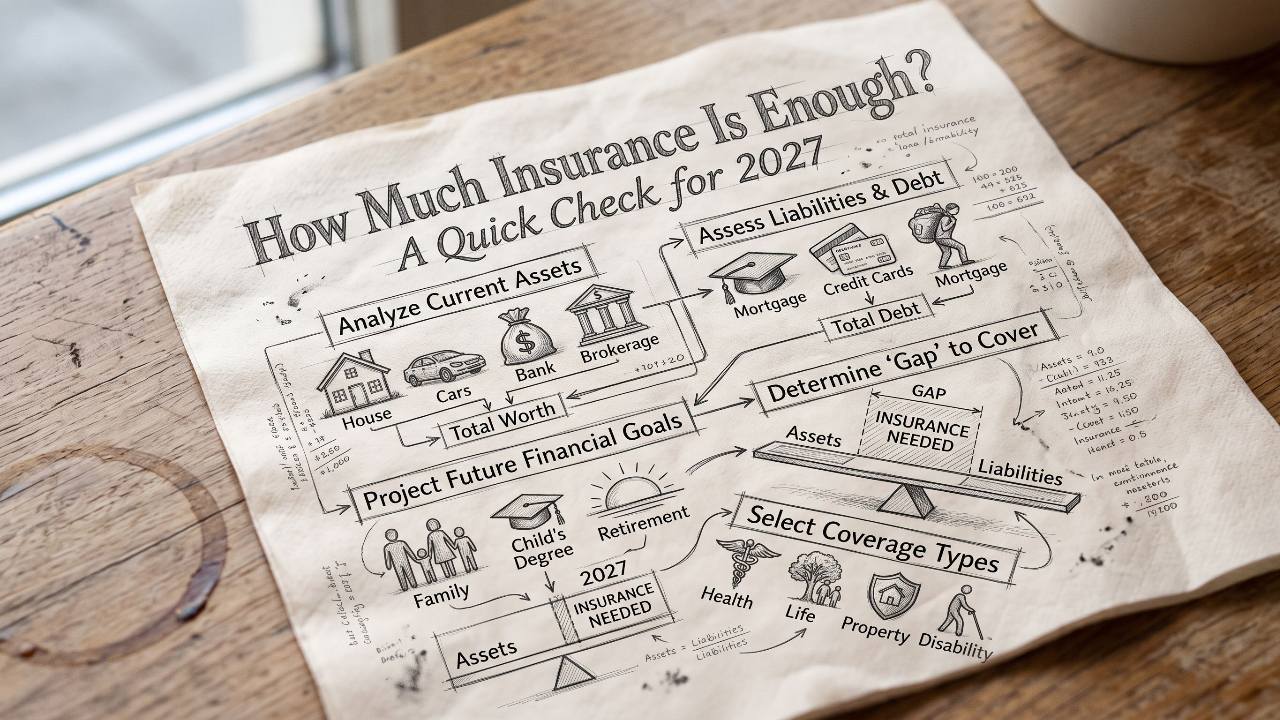
Checking your coverage doesn’t require a full weekend retreat. Set a recurring calendar reminder for the same weekend every year and run through four quick steps:
-
Check life triggers: Did you buy a home, marry, divorce, or welcome a kid in the last twelve months? Adjust term life limits accordingly.
-
Review auto liability lines: Verify you are well above state minimum limits on liability and property damage.
-
Raise deductibles where practical: If your emergency fund is healthy, raising your deductible from $500 to $1,000 or $1,500 will immediately lower your monthly premiums.
-
Bundle and re-quote: Ask your current carrier for an updated multi-policy discount, or grab a quick comparison quote to keep them honest.
Reviewing your coverage isn’t the most glamorous way to spend an afternoon, but finding out you are short on coverage after a disaster strikes is infinitely worse. Spend a few minutes running the numbers today, lock in the right protection, and get back to living your life without worrying about worst-case scenarios.