
Every time someone brings up Bitcoin at a dinner party, the room splits into two camps: the person enthusiastically using buzzwords like “cryptographic hashing” until everyone’s eyes glaze over, and the rest of the table desperately pretending to check their phones. Most explanations sound like they were written by an alien math professor who only speaks in computer code.
Strip away the techno-babble, though, and the core concept is surprisingly straightforward. Bitcoin is essentially a clever way to pass value to someone over the internet without needing a trusted middleman—like a bank, payment processor, or nosy government—to approve it.
The Fundamental Problem with Digital Cash
To understand why Bitcoin exists, think about regular files on your laptop. If you email a friend a funny cat meme, you haven’t given away your meme. You kept the original file and sent them a copy. Both of you now own the meme, and the internet didn’t break.
If you try that with digital money, society collapses before lunch. If you could copy-paste a digital $10 bill, you could spend it at the grocery store, paste it again to pay your electricity bill, and paste it a third time to buy pizza. In computer science, this nightmare is known as the “double-spend problem.”
Historically, we solved this by putting a giant referee in the middle: a bank. When you swipe your card, the bank opens its private notebook (a database ledger), deducts $10 from your account, and credits $10 to the merchant. The bank guarantees you didn’t spend the same money twice. The catch? You have to trust that the bank won’t freeze your funds, charge you ridiculous overdraft fees, or take three business days to move your own money across an imaginary border.
Enter the Shared Google Doc Nobody Can Edit
In 2008, a mysterious programmer (or group) named Satoshi Nakamoto proposed a radical alternative: What if, instead of trusting one central referee, everyone in the game kept an identical copy of the referee’s notebook?
This distributed notebook is what people call a blockchain. Imagine a giant, shared spreadsheet where every single Bitcoin transaction ever made is recorded.
-
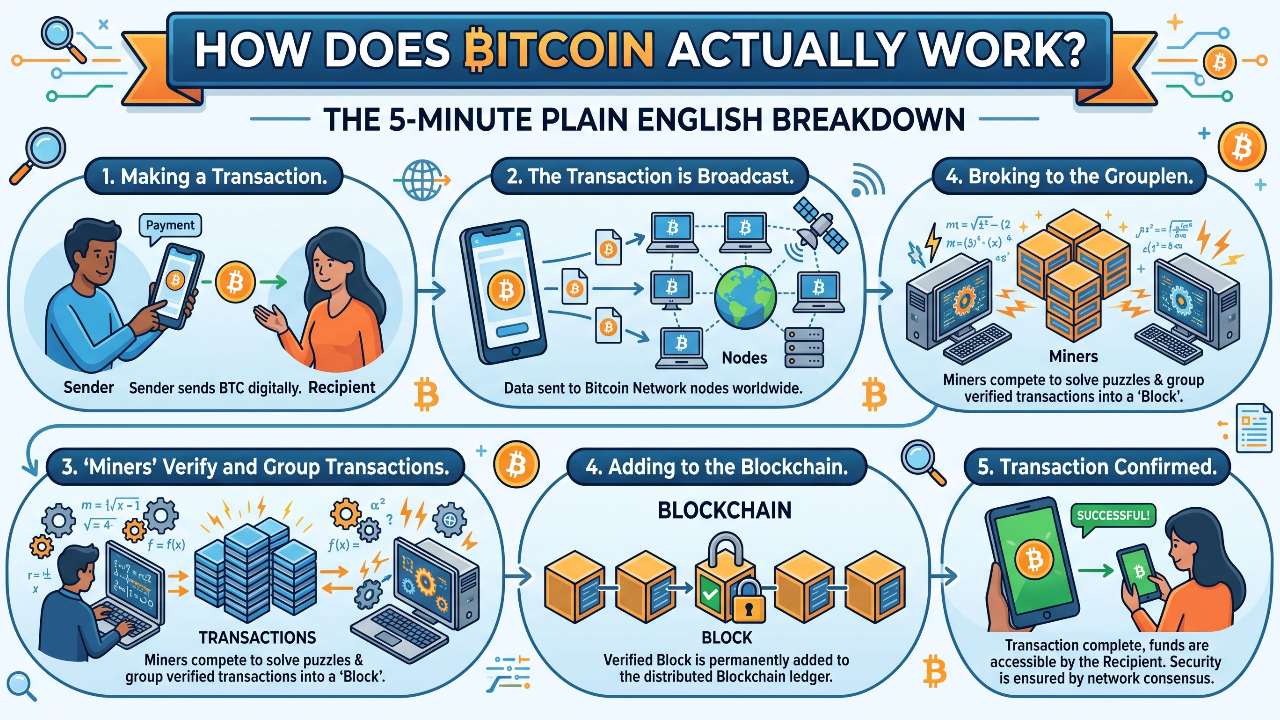
Everyone gets a copy: Thousands of independent computers around the world (called nodes) run the Bitcoin software and hold an identical copy of this historical ledger.
-
Write-only access: You can only add new transactions to the bottom of the list. You cannot go back to page 42 and scribble out a purchase you regret.
-
Total visibility: Anyone can inspect the ledger to see if a specific digital address actually has the funds it claims to spend.
Keys: How You Actually Own and Move Money
You might wonder: if the entire ledger is public, what stops someone from transferring all of your coins to themselves? That comes down to digital cryptography, which acts like an ultra-secure lock-and-key system. Every Bitcoin wallet comes with two distinct components:
-
The Public Key (Your Address): This is like your email address or bank account routing number. You can post it on your website or text it to a friend so they can send you funds. It’s completely safe to share.
-
The Private Key (Your Password): This is a massive, mathematically generated secret key. It functions like your digital signature. Whoever holds the private key controls the coins. If you leak it, your funds vanish; if you lose it, your funds are locked in digital purgatory forever with no customer support hotline to rescue you.
When you send Bitcoin, your wallet uses your private key to generate a unique digital signature that proves to the network: “Yes, I truly own these coins, and I authorize moving them to this new address.”
What Are “Miners” Actually Doing?
You’ve probably heard stories about “Bitcoin miners” running warehouses full of whirring computers in cold climates, burning through electricity like a small nation. Are they digging for digital gold? Not quite.
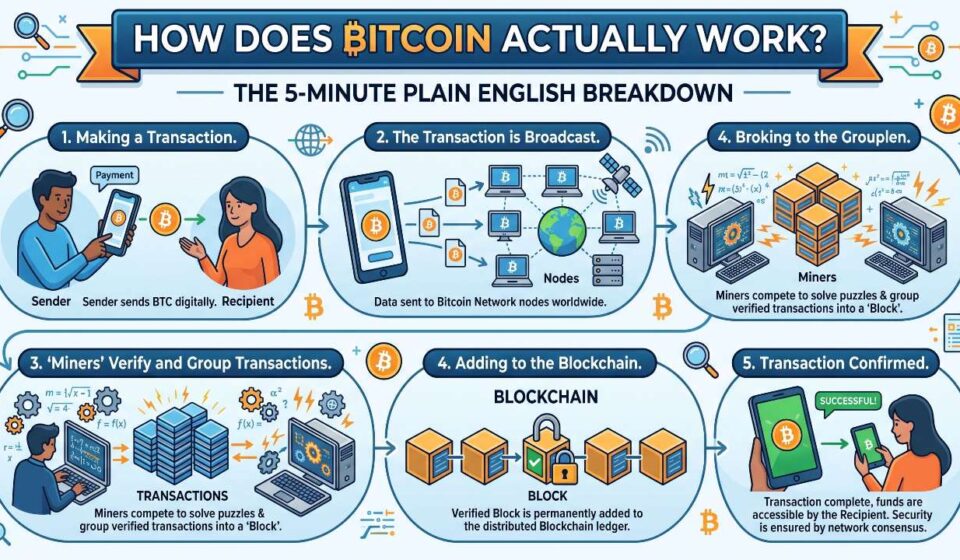
Miners are essentially the network’s auditors and security guards. They bundle hundreds of recent transactions into a single “block” and race against one another to solve an extremely difficult, arbitrary mathematical guessing game—a mechanism known as Proof of Work.
Think of it like an enormous lottery where computers guess random numbers billions of times per second until one machine finds a lucky answer that fits the puzzle.
-
Solving the puzzle: The winning miner broadcasts their solved block to the rest of the network.
-
Instant verification: While finding the answer takes massive computational effort, verifying it takes milliseconds for every other computer.
-
Chaining the block: Once verified, the new block is cryptographically linked to the previous block, extending the chain.
-
The payout: As a reward for their electricity bill and honesty, the winning miner receives newly minted Bitcoin plus the transaction fees attached to that block.
If a dishonest miner tries to slip a fake transaction into their block (e.g., giving themselves 500 free Bitcoins), the rest of the network checks the math, rejects the entire block immediately, and the rogue miner wastes all the electricity spent on that attempt without getting paid a single satoshi.
Bitcoin vs. Traditional Banking: Side-by-Side
To see why this architecture is so fundamentally different from your everyday bank account, look at how the mechanics compare:
| Feature | Traditional Bank | Bitcoin Network |
| Who Runs It? | Centralized corporations & central banks | Decentralized, open-source computer network |
| Account Creation | Requires ID, credit checks, and paperwork | Open to anyone with an internet connection |
| Transaction Approval | Bank employees and automated clearinghouses | Thousands of independent nodes via mathematical consensus |
| Reversibility | Chargebacks and wire cancellations are common | Irreversible once confirmed on the blockchain |
| Supply Limit | Unlimited (governments can print more at will) | Hard-capped strictly at 21 million coins |
| Operating Hours | Mon–Fri business hours (closed holidays) | 24/7/365, never sleeps or pauses |
The Hard Cap: Why Digital Scarcity Matters
One of the most defining design choices of Bitcoin is its hard limit: there will only ever be 21 million bitcoins in existence.
Unlike traditional fiat currencies (like the US Dollar or Euro), which central banks can expand during financial crises, Bitcoin’s emission schedule is hardcoded into its protocol. Approximately every four years, an event called the “Halving” cuts the reward miners receive in half, slowing down the rate of new coins entering circulation until the final fraction of a coin is minted around the year 2140.
This predictable, automated schedule creates genuine digital scarcity. Before Bitcoin, if something existed solely as code, it could be duplicated infinitely. Satoshi’s design created a digital item that behaves more like gold: durable, divisible, scarce, and impossible to counterfeit.
The Trade-offs: It’s Not Magic
While the engineering behind Bitcoin is brilliant, it comes with real-world frictions that anyone using it quickly discovers:
-
Zero safety nets: There is no “forgot password” link. If you lose your private key or send funds to an incorrect address, that money is gone for good.
-
Price volatility: Because Bitcoin isn’t tied to a physical commodity or backed by a government, its price fluctuates wildly based on market supply and demand.
-
Throughput limits: Because every transaction must be synchronized across a decentralized network, the base layer handles only about 7 transactions per second globally (compared to Visa’s tens of thousands), which has spurred secondary payment systems like the Lightning Network.
At its heart, Bitcoin isn’t magical space currency or an impenetrable riddle. It is simply a shared, self-verifying public ledger secured by competitive math instead of corporate trust. Whether you view it as revolutionary sound money or an over-engineered spreadsheet, it fundamentally proved that humans can exchange value across the globe without asking anyone for permission.